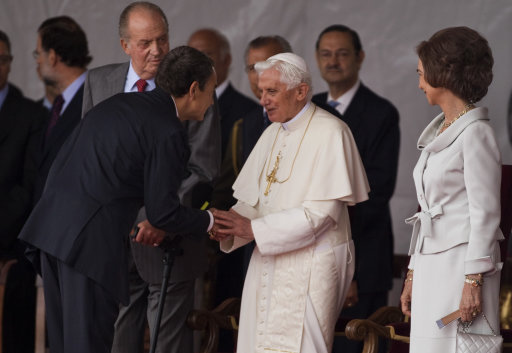
In the seven years since the Socialist swept to power prime minister José Luis Rodríguez
Zapatero has worked
systematically to undermine the teachings of the Catholic church.
Mr Zapatero and his Socialist Workers Party party have presided over a nearly
unrelenting march of secularism, often appearing to deliberately provoke the
Vatican and Spain's Catholic establishment.
With 15 months of becoming premier, Mr Zapatero legalised same-sex marriage in
a broad-ranging law that also extended adoption rights to homosexual
couples.
Large protests in Madrid were backed by the Catholic Church but
ignored by the government.
Laws were also pushed through to drop religious education in state schools.
The Left-wing prime minister pointedly refused to attend an open-air Mass held by the Pope during a 2006 visit to
Spain. Vatican sources bitterly complained that even Communist leaders like
Fidel Castro and Daniel Ortega had attended the previous pope's masses as a
mark of respect.
The government then fully legalised abortion - allowing terminations at 16 as
long as the girl's parents are informed and permitting abortions on demand
in the first 14 weeks of a pregnancy.
While Mr Zapatero makes no apologies for his secular ambitions, the country he
leads has shed much of its traditional Catholicism organically.
Around 80 per cent of Spaniards describe themselves as Roman Catholic but only
25 per cent attend church regularly. Divorce was illegal until 1981 but now
ends around 50 per cent of all marriages.
Premarital sex is common and the Church's teaching on contraception is
regularly ignored.
Such is the Vatican's concern at the loss of one Europe's most traditionally
Catholic countries that the Pope has made three visits since 2005, more than
any other country except his native Germany.
For Spain's Catholics there are some reasons for optimism. Mr Zapatero announced
in April that he will not stand in next year's general election, a
contest the Socialists look likely to lose to the conservative People's
Party.
The pace of his secular revolution has also slowed as his slumping popularity.
Last year the government delayed a bill that would have required the removal
of crucifixes from public places and ended state Catholic funerals.
Speaking at the time, theologian Juan José Tamayo said the government was
already struggling against conservative opponents who hammered them over the
weak economy.
“They don't want to add more wood to the fire.”


No comments:
Post a Comment